


Have you ever wondered how organizations can balance security and flexibility in their IT infrastructure? The answer lies in the concept of dedicated environments that cater specifically to a single organization. These tailored solutions, often referred to as private clouds, provide unique benefits that can transform the way businesses manage their data and applications.
Modern enterprises face the challenge of evaluating their IT infrastructure to ensure it meets their specific needs. By considering the advantages of a private cloud, organizations can maintain total control over their resources while ensuring that sensitive data remains secure. This approach not only enhances performance but also allows for scalability that adapts to changing business demands.
As companies navigate the complexities of cloud computing, understanding when to transition to a private cloud environment becomes crucial. The right decision can lead to improved security, better resource management, and an overall boost in operational efficiency.
Key Takeaways
- Private clouds offer dedicated environments for enhanced control and security.
- Organizations must assess the cost-benefit of private versus public cloud solutions.
- Data protection is a key advantage of using private cloud resources.
- Scalability and flexibility are essential features of private cloud environments.
- Choosing the right cloud model is vital for long-term data management success.
Overview of Cloud Computing Models
Navigating the cloud landscape requires a clear understanding of various deployment models. Each model offers distinct advantages and is tailored to different organizational needs.
The public cloud operates as a multi-tenant environment, where resources are shared among numerous customers. This model functions like a utility service, allowing organizations to access computing resources on a subscription basis.
In contrast, private clouds provide a single-tenant environment, ensuring that all resources are dedicated to one organization. This setup enhances security and offers isolated access to sensitive data.
A hybrid cloud combines elements of both public and private clouds, creating a flexible infrastructure. This allows organizations to migrate workloads seamlessly between different environments.
Current trends indicate that many organizations are adopting multicloud strategies. This approach enables them to leverage the best services from various cloud providers, optimizing their data management and application performance.
What is a Private Cloud: Fundamentals and Advantages
In today’s digital age, understanding dedicated computing environments is essential for organizations. A private cloud serves as a single-tenant environment, providing exclusive access to computing power, storage, and networking. This setup ensures that no other users share the underlying hardware, enhancing both security and performance.
According to a report from Future Markets Insights, the global private cloud services market is projected to grow significantly, from USD 124.6 billion in 2025 to USD 618.3 billion by 2035. This growth highlights the increasing demand for tailored cloud solutions.
These clouds offer enhanced security features, such as firewalls, virtual private networks, and data encryption. Such measures are crucial for protecting sensitive data, including medical records and financial information. Organizations often choose private cloud solutions to meet strict regulatory requirements that public clouds may not satisfy.
By building a private cloud architecture, companies gain the flexibility to customize their infrastructure. This ensures consistent performance for their most critical business workloads, making it an ideal choice for many enterprises.
Benefits of Private Cloud for Enterprises
Organizations today are increasingly recognizing the strategic advantages of tailored cloud environments. By leveraging a private cloud, businesses can enhance their control over infrastructure and data.
Private cloud platforms allow enterprises to choose their hardware and software, aligning their infrastructure with specific technology and business requirements. This level of customization ensures that the cloud environment meets unique operational needs.
Moreover, since all workloads operate behind the customer’s firewall, these clouds provide greater visibility into security and access controls compared to public cloud alternatives. This is essential for organizations that prioritize data protection.
- Enhanced compliance is a significant benefit, allowing organizations to dictate where their data is stored.
- Private clouds offer consistent performance, as resources are not shared with other users, preventing contention.
- Enterprises can customize their servers and software, ensuring a perfect fit for their operational demands.
For a deeper understanding of the differences between cloud solutions, check out this comparison of private and public clouds.
Private Cloud vs. Public Cloud and Hybrid Cloud Comparison
Choosing the right cloud environment can significantly impact an organization’s operational efficiency. Understanding the differences between private, public, and hybrid clouds is essential for informed decision-making.
The public cloud provides substantial benefits, such as greater elasticity and scalability. This model allows organizations to manage unexpected traffic surges without investing in new hardware.
In contrast, while the private cloud often comes with higher costs due to hardware investments, it offers predictable performance and enhanced security for sensitive workloads. This control is vital for organizations that prioritize data protection.
A hybrid cloud combines both environments, allowing enterprises to keep sensitive data on-premises while leveraging the public cloud for additional capacity or applications.
Organizations must evaluate their resource allocation needs carefully. Private cloud environments typically require significant upfront capital expenditures, unlike the pay-per-use model of public clouds.
| Feature | Private Cloud | Public Cloud | Hybrid Cloud |
|---|---|---|---|
| Cost | Higher upfront costs | Lower entry costs | Variable, depending on usage |
| Control | Full control | Limited control | Partial control |
| Scalability | Limited by hardware | Highly scalable | Flexible scalability |
| Security | Enhanced security | Standard security | Variable security |
By comparing these solutions, businesses can determine whether the scalability of the public cloud or the security of the private cloud better supports their long-term IT strategy.
Exploring Private Cloud Deployment Models
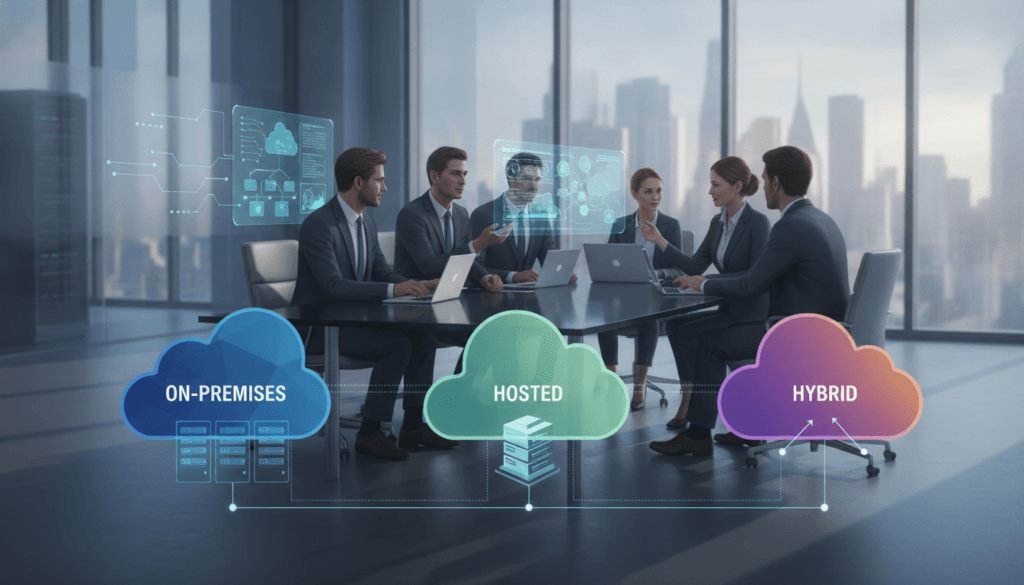
Understanding the different deployment models of cloud solutions can help organizations optimize their IT strategies. Each model offers unique advantages that align with specific operational needs. Below are the primary types of private cloud deployment models:
- On-Premises Private Cloud: This model requires organizations to manage everything, from hardware purchases to data center operations.
- Virtual Private Cloud (VPC): A service from a public cloud provider that creates a logically isolated space on shared infrastructure.
- Hosted Private Cloud: Operated off-premises on a third-party vendor’s servers, where the provider manages maintenance and security.
- Managed Private Cloud: Involves outsourcing deployment and maintenance to providers like Amazon Web Services or IBM Cloud.
Each deployment model offers different levels of flexibility and control. Organizations can choose the right balance of performance and costs for their specific needs.
Technical Components of a Private Cloud Environment
The foundation of a successful cloud strategy lies in understanding the essential components that drive its performance. In a private cloud, several key technologies work together to ensure efficiency and security.
Virtualization, Automation, and Cloud Management Software
Virtualization is a core component that enables IT resources to be abstracted from physical hardware. Software like VMware or Hyper-V creates shared resource pools, maximizing utilization.
Cloud management software provides centralized control over the infrastructure and applications within a private cloud environment. This optimizes both security and availability.
Automation plays a crucial role in streamlining tasks such as server provisioning and deployment workflows. This reduces the need for human intervention and allows for self-service resource delivery.
Infrastructure Scalability and Performance Optimization
By implementing these technologies, organizations can quickly scale their infrastructure in response to usage spikes. This ensures high performance for all workloads.
These technical components allow a private cloud to provide the same elasticity and scalability as other cloud environments while maintaining dedicated hardware for the customer.
Integrating Private Cloud in a Hybrid Multicloud Strategy
Incorporating diverse cloud strategies allows organizations to optimize their IT resources effectively. A hybrid multicloud approach provides the flexibility to select the best environment for each workload or application.
According to the 2022 IBM Transformation Index, over 77% of business and IT professionals have adopted this hybrid approach. By integrating an on-premises private cloud with public cloud services, organizations can secure sensitive data while enjoying the public cloud’s flexibility.
This strategy is particularly beneficial for industries like finance and healthcare, which must meet strict regulatory compliance requirements. Additionally, effective integration relies on orchestration tools that facilitate seamless workload migration, ensuring performance and security standards are met across all cloud services.

Private Cloud Use Cases in Modern Enterprises
In an era of rapid technological advancement, organizations are exploring tailored cloud environments for their unique needs. The private cloud plays a pivotal role in this transformation, especially in application modernization and edge computing.
Application Modernization and Edge Computing
Private clouds support application modernization by providing the infrastructure necessary to upgrade legacy systems. This ensures organizations maintain control over their environment and data. Additionally, organizations can utilize private cloud infrastructure at the edge. This allows them to process sensitive data locally, facilitating real-time, data-driven decisions in industries like healthcare.
AI-Driven Security and Data Management Strategies
Companies are leveraging artificial intelligence within private cloud environments to enhance security operations. By analyzing historical data, they can identify patterns and anomalies, strengthening their defenses. For instance, Delta Air Lines partnered with IBM to transform its operations through a hybrid cloud migration, showcasing the effectiveness of these solutions.
Using private clouds for AI-driven security enables enterprises to detect threats in real time. This capability ensures that their data management strategies remain robust and compliant with regulatory requirements.
Conclusion
In the evolving landscape of IT, the integration of tailored cloud solutions has become crucial for businesses. Rethinking IT infrastructure through dedicated environments allows organizations to balance security and control with the advantages of modern cloud computing.
As companies manage sensitive data, the ability to customize their infrastructure while ensuring compliance remains a key driver for adoption. While costs and maintenance are important considerations, the performance and flexibility offered by these solutions often justify the investment.
Moreover, integrating private clouds into a broader hybrid strategy enables businesses to scale operations while keeping critical applications secure. Ultimately, selecting the right cloud environment depends on specific requirements for performance, security, and long-term growth.