

As a business leader in Hong Kong, you know the feeling. The relentless pace of the market demands not just speed, but unshakable stability. Your company’s data is its lifeblood, and the thought of it being vulnerable can keep you up at night.
What if your digital foundation could be as resilient and focused as your team? A private cloud provides that dedicated digital environment, built exclusively for your enterprise. It’s about having control and confidence in a world full of digital uncertainty.
The global shift towards these secure solutions is massive. Studies project the cloud market to grow toward a staggering USD 618.3 billion by 2035. In Hong Kong’s competitive landscape, this isn’t just a trend; it’s the new baseline for operational excellence.
ReadySpace delivers that reliability. We build solutions that offer the perfect balance, giving your team the flexibility to scale while fiercely guarding your data integrity. It’s more than technology; it’s a partnership for your long-term success.
Key Takeaways
- A dedicated private cloud environment offers enhanced control and security for sensitive business data.
- The global market for these solutions is expanding rapidly, highlighting their critical role in modern business.
- Tailored infrastructure is essential for meeting the specific demands of the competitive Hong Kong market.
- Advanced technology provides a significant competitive edge by optimizing performance and reliability.
- Scalable operations are possible without compromising on the safety of your information.
- Choosing the right provider is a strategic decision that impacts your long-term digital transformation.
- Robust data protection is non-negotiable for maintaining customer trust and business continuity.
Introduction to the Ultimate Guide on Private Cloud Services
The journey to a robust digital foundation begins with a deep dive into the solutions designed to protect and empower your operations. This ultimate guide explores dedicated private cloud services, providing the essential security and control modern organizations need.
We’ll examine the fundamental differences between various infrastructure models. This knowledge helps your business make an informed, strategic decision for the long term.
Our analysis covers core benefits like enhanced data privacy and hardware customization. You will learn to navigate complexity while ensuring compliance with local and international standards.
By the end, you’ll understand how to implement a strategy that supports real growth. It’s about building a resilient, future-proof enterprise.
What Are Private Cloud Services? Understanding Definitions and Benefits
At its core, a private cloud is a dedicated digital ecosystem, isolating your business from the shared noise of public platforms. It is a single-tenant environment where all computing resources are reserved for one organization.
This exclusivity is a major driver for growth. Future Markets Insights reports the market for these solutions will rise from USD 124.6 billion in 2025 to USD 618.3 billion by 2035.
Key Features and Advantages
Complete isolation is the standout feature. Your company’s information and applications operate on infrastructure no one else can access.
This setup provides full command over hardware and software. Such authority is vital for managing confidential intellectual property or financial records.
Security, Control, and Customization
The primary benefits include enhanced security and the ability to tailor systems. Businesses can meet specific regulatory compliance needs that other models cannot satisfy.
By keeping data within this dedicated space, firms ensure it stays protected behind their own firewalls. Strict access policies add another layer of control.
| Aspect | Description | Business Impact |
|---|---|---|
| Isolation | Dedicated resources for one tenant only | Eliminates “noisy neighbor” risks, ensures consistent performance |
| Control | Full authority over hardware, software, and network settings | Enables precise configuration for specialized workloads |
| Security | Data protected by private firewalls and access controls | Strengthens defense against breaches, builds customer trust |
| Customization | Infrastructure tailored to exact operational and compliance needs | Simplifies adherence to regulations like Hong Kong’s data laws |
For enterprises in Hong Kong, this combination of safety and adaptability delivers tangible value. It turns IT infrastructure into a strategic asset.
Private Cloud Services vs. Public and Hybrid Clouds
The landscape of cloud computing presents several distinct paths, each with unique implications for your business. Understanding the core differences helps you select the right foundation for growth and safety.
Comparing Resource Sharing and Security
A public cloud operates on a shared, multi-tenant model. Many customers use the same pool of computing resources. This can be cost-effective but may raise concerns about data isolation and consistent performance.
In contrast, a private cloud provides a dedicated environment. Your firm’s information and applications are completely isolated. This setup offers higher levels of security and predictable performance from the start.
Why Organizations Choose Private over Public Cloud
Many organizations select a private deployment for handling sensitive data. This includes personally identifiable information or strict medical records. The need for verifiable security protocols and compliance often drives this choice.
Your team gains complete authority over the underlying infrastructure and settings. This level of control is crucial for specialized workloads. A 2022 IBM report found over 77% of professionals use a hybrid cloud approach to balance these needs.
Choosing the right model depends on your specific requirements. Consider your needs for cost, scalability, and control over critical applications. The best path aligns with your long-term operational goals.
Deployment Models for Private Cloud Infrastructure
The way you implement your dedicated digital environment can significantly impact control, cost, and scalability. Several distinct paths exist for setting up this infrastructure. Each offers a different balance of ownership and management effort.
On-Premises Private Cloud
This model requires your company to manage all hardware and software within its own data center. It provides maximum control but involves higher upfront costs. Your internal IT team handles every aspect, from procurement to maintenance.
Virtual Private Cloud (VPC)
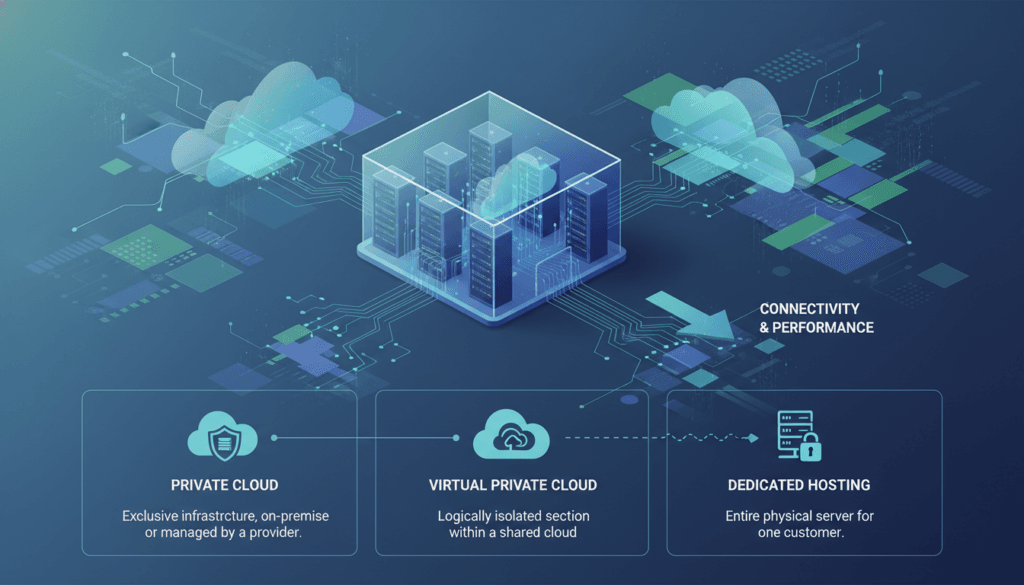
A VPC creates a logically isolated space within a public provider’s infrastructure. It offers a balance of cost and security. You gain dedicated resources without managing physical servers.
Hosted and Managed Private Cloud Solutions
Here, a third-party provider maintains physical servers in an off-site facility. This reduces the burden on your internal team. Hosted private cloud solutions add support for maintenance, patching, and updates.
| Deployment Model | Key Feature | Best For |
|---|---|---|
| On-Premises | Full control over hardware and software in your own data center | Organizations with strict compliance needs and dedicated IT staff |
| Virtual Private Cloud (VPC) | Logical isolation within a public cloud provider’s network | Businesses seeking a balance of cost, security, and scalability |
| Hosted/Managed | Off-site servers maintained by a third-party provider | Companies wanting reduced management overhead and expert support |
Each deployment model offers unique advantages. Your priority might be total ownership or operational efficiency. Choosing the right one aligns your technology with long-term goals.
Key Technologies Empowering Private Cloud Solutions
The engine of a modern digital environment is powered by a suite of sophisticated technologies. These tools transform dedicated hardware into a dynamic, intelligent platform.
They provide the control and efficiency your business needs. Two core categories make this possible.
Virtualization and Cloud Management Software
Virtualization software is the foundational layer. Platforms like VMware and Hyper-V partition physical servers into multiple virtual machines.
This creates shared pools of computing resources for better utilization. Cloud management platforms then give admins a central dashboard.
From here, they can monitor and optimize the performance of the entire environment.
Automation Tools and Orchestration
Automation is essential for operational speed. These tools rapidly provision new resources and deploy applications.
This reduces manual work and human error. Orchestration platforms take this further.
They coordinate complex tasks across your infrastructure. Resources are always allocated to the right applications seamlessly.
Together, these technologies deliver public cloud agility within a secure, private framework.
| Technology Category | Core Function | Primary Business Benefit |
|---|---|---|
| Virtualization Software | Abstracts physical hardware into virtual resource pools | Maximizes server utilization and enables workload isolation |
| Cloud Management Software | Provides centralized monitoring and control dashboards | Gives administrators full visibility and simplifies optimization |
| Automation Tools | Scripts and accelerates provisioning and deployment tasks | Dramatically reduces manual effort and speeds up operations |
| Orchestration Platforms | Coordinates complex workflows across the entire infrastructure | Ensures efficient, error-free resource allocation and application support |
Securing Your Dedicated Private Cloud Environment
Protecting your enterprise data requires a multi-layered approach that addresses both technical and regulatory challenges. This dedicated digital space demands comprehensive safeguards.

A robust strategy combines technology with vigilant processes. Let’s explore the key components.
Implementing Robust Cloud Security Measures
A strong defense starts with foundational tools. Firewalls, VPNs, and advanced encryption for sensitive information create essential barriers.
Leading providers, like OVHcloud, adopt frameworks such as SecNumCloud. This ensures their hosted infrastructure meets strict business requirements.
Regular audits and strict access controls are crucial. Implementing API keys guarantees only authorized personnel interact with your data.
Ensuring Regulatory Compliance in Hong Kong
Local data privacy laws add another layer of complexity. Your security practices must align with these regulations to avoid legal issues.
Prioritizing these measures protects against evolving threats. It also maintains the trust of your customers and governing bodies.
Ensuring Scalability and Optimal Performance
A truly resilient digital operation hinges on two critical pillars: the ability to grow seamlessly and the assurance of unwavering system responsiveness.
Your infrastructure must adapt to demand without delay. This requires a foundation designed for both expansion and reliability.
Resource Elasticity and High Availability
Resource elasticity lets your system adjust computing power dynamically. It matches the real-time needs of your applications.
This prevents waste during quiet periods. It also handles sudden traffic spikes smoothly.
High availability is maintained through built-in redundancy. If one component fails, another takes over instantly.
Your services stay operational without interruption. This is crucial for user trust and business continuity.
Optimal performance comes from dedicated resources. You avoid the “noisy neighbor” effect common in shared environments.
Close monitoring ensures consistent speed. It also helps plan for future scalability needs.
| Focus Area | Key Mechanism | Business Outcome |
|---|---|---|
| Scalability | Planning for hardware capacity and dynamic resource allocation | Handles growth and traffic surges without performance loss |
| Performance | Using dedicated, non-shared infrastructure components | Delivers consistent, high-speed application response times |
| Availability | Implementing redundant systems across the network and servers | Guarantees near 100% uptime and service continuity |
| Elasticity | Automatically scaling computing power and storage up or down | Aligns costs with actual usage and maintains efficiency |
For a detailed look at implementing such a robust system, explore the best cloud host solutions in Hong. The right setup turns your digital environment into a powerful growth engine.
Cost Considerations and the Value Proposition of Private Cloud Services
Financial planning for your IT infrastructure requires a clear-eyed look at both immediate expenses and future returns. A dedicated environment often involves a significant initial investment.
This typically includes purchasing physical hardware like servers and storage arrays. For many organizations, this capital outlay is a major budgetary decision.
Evaluating Upfront Investments and Long-Term Savings
While setup costs are higher, a private cloud can lead to substantial savings over time. This is especially true for firms with steady, predictable operational demands.
You must evaluate the total cost of ownership carefully. Expenses for specialized IT staff to manage the infrastructure add to the long-term financial picture.
Comparing the expense of maintaining your own hardware versus using a hosted private cloud service is crucial. This analysis helps identify the most efficient strategy for your business.
The core value of these services isn’t just in cost. It lies in the unparalleled control and security they deliver, which can prevent extremely expensive data breaches.
Real-World Use Cases: How Private Cloud Brings Business Value
Across industries, forward-thinking companies are leveraging isolated digital infrastructures to solve real business challenges. These environments provide tangible benefits that go beyond theory.
Application Modernization and Legacy Integration
Many firms face the dilemma of outdated systems. A dedicated environment allows for application modernization without a full rewrite.
This approach lets organizations integrate legacy software into a secure, modern framework. Operational efficiency improves while protecting existing data.
Supporting Hybrid Multicloud Strategies
A hybrid cloud strategy is increasingly common. It enables workloads to move between environments based on cost and performance needs.
Delta Air Lines partnered with IBM to transform its business operations using a hybrid approach. This move drove innovation and enhanced customer experiences.
These examples show how a well-implemented private cloud serves as the backbone for an agile, secure digital business strategy.
Future Trends and Innovations in Private Cloud Computing
Innovation never sleeps, and the next generation of dedicated digital infrastructure is already taking shape. Several key trends are set to redefine how businesses build and manage their technology.
These advancements promise greater agility and smarter operations for firms in Hong Kong.
Automation, Edge Computing, and Self-Service Models
Automation is becoming the backbone of modern infrastructure. It allows developers to provision resources instantly, without waiting for IT teams.
This self-service model speeds up innovation cycles dramatically. Another major trend is edge computing.
Organizations are extending their private clouds to local sites. This processes data closer to where it is created, reducing latency.
The Rise of Software-Defined Infrastructure
Software-defined infrastructure is transforming management. It abstracts physical hardware into programmable layers.
This shift increases agility and cuts down on manual configuration tasks. The result is a more responsive and efficient system.
As these technologies evolve, private clouds will integrate more seamlessly with public environments. This creates a unified experience for handling complex, distributed workloads.
Serverless computing within these dedicated spaces is also on the horizon. It will further simplify how developers build and deploy modern applications.
Conclusion
Navigating the complexities of modern IT requires a foundation that balances robust security with operational agility. This guide has explored how dedicated environments provide that essential equilibrium.
These solutions offer unparalleled control and data protection, making them ideal for sensitive workloads. Understanding the differences between public, hybrid, and private models helps you build a resilient infrastructure for long-term growth.
Your success hinges on selecting the right provider and management strategy. As technology evolves with software-defined advances, your chosen platform will remain a vital asset for digital transformation.
We hope this information provides clarity for your journey. Align your technology with specific business goals and compliance needs to secure a scalable and successful future.